Almost all the routes in this guide have no fixed gear so everything you
need has to be carried with you. It is always worth taking a bit of time to
scan a route to envisage the runner placements that might be available.
It may seem obvious but wide cracks need big runners so starting up
an off-width with a bunch of small wires doesn't make any more sense
than setting off up a blank slab with a set of big cams, "just in case"!
Runners
Many old routes which were bold and unprotected leads in their day are
now relatively safe with modern protection. A typical general gritstone
rack will consist of a set of wires and a range of cams; the wide breaks
and many cracks make gritstone ideal for camming devices. Hexes
are a cheaper alternative though they are less versatile and are much
noisier! Wires are useful for the narrow cracks plus a couple of slings
for threads and for lassoing blocks and boulders at the cliff-top belays.
For harder routes, micro-wires, tiny cams and other more advanced
devices may be essential.
Ropes
Most grit routes are short enough to be climbed on a single rope, either
10mm or a triple-rated thinner rope. The only exceptions are routes
which wander around in which case you need two half-ropes, or you
can use one rope doubled up - colour confusion guaranteed.
Other Gear
Beyond these essentials you may also find useful: a poker for (gently) removing stubborn
gear; tape for bandaging your hands before, or after, they are wrecked by some savage
crack; a toothbrush for brushing smaller holds on hard routes. A bouldering mat can be very
welcome on unprotected starts. The only other thing you need is in your hands now!
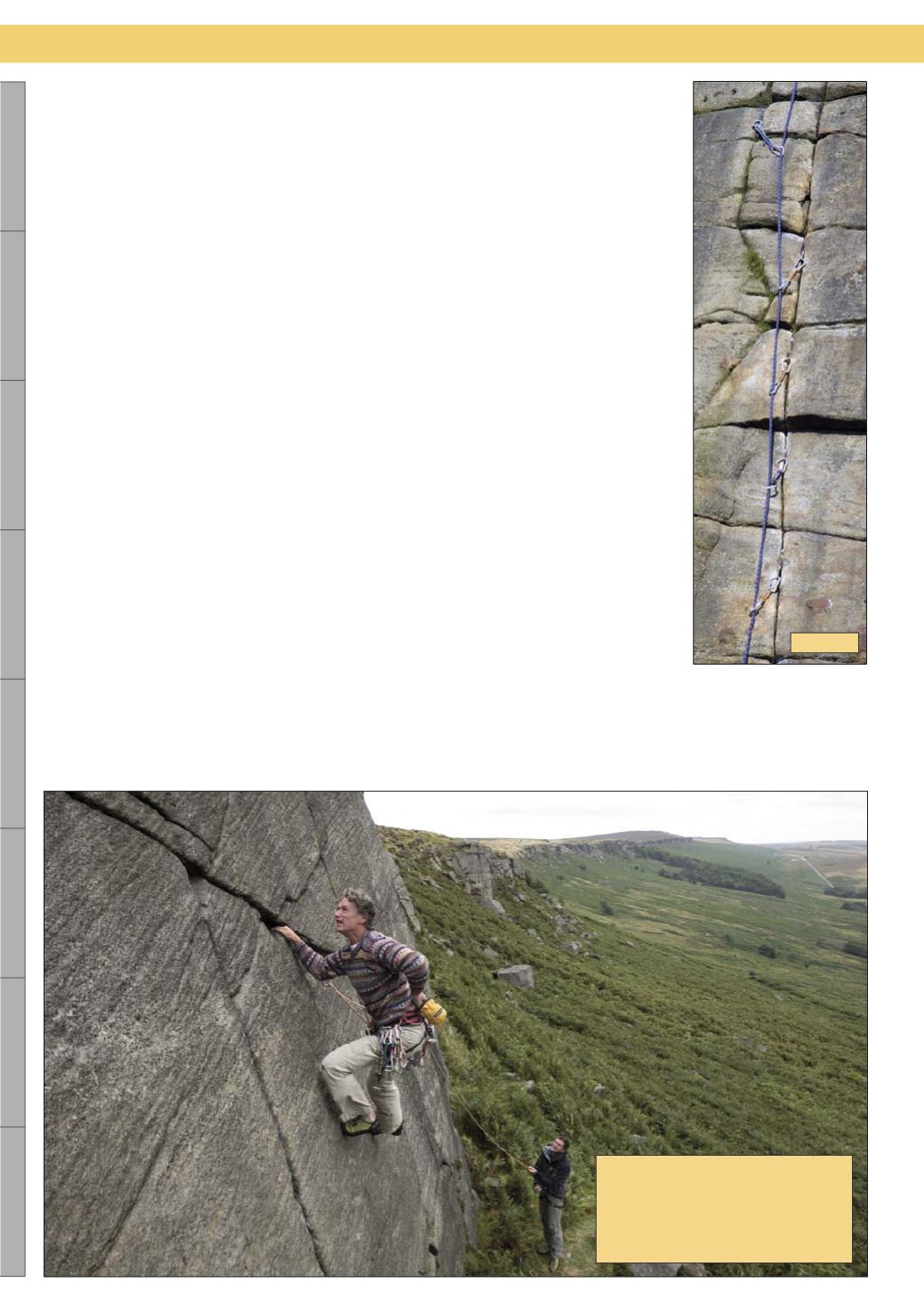
Dave Clay and Steve Cunnington away
from it all on
Sneaking Sally Through
the Alley
(VS 4c)
-
page 169
- at
Stanage North. Dave's gear matches the
route well - a short climb up a thin crack
= single rope, wires and small cams.
Sheffield Area
Ladybower Area
Stanage
BurbageValley
Millstone Area
Derwent Edges
Chatsworth Area
Southern Crags
Laced up!
28
Eastern Grit Climbing
Gear


