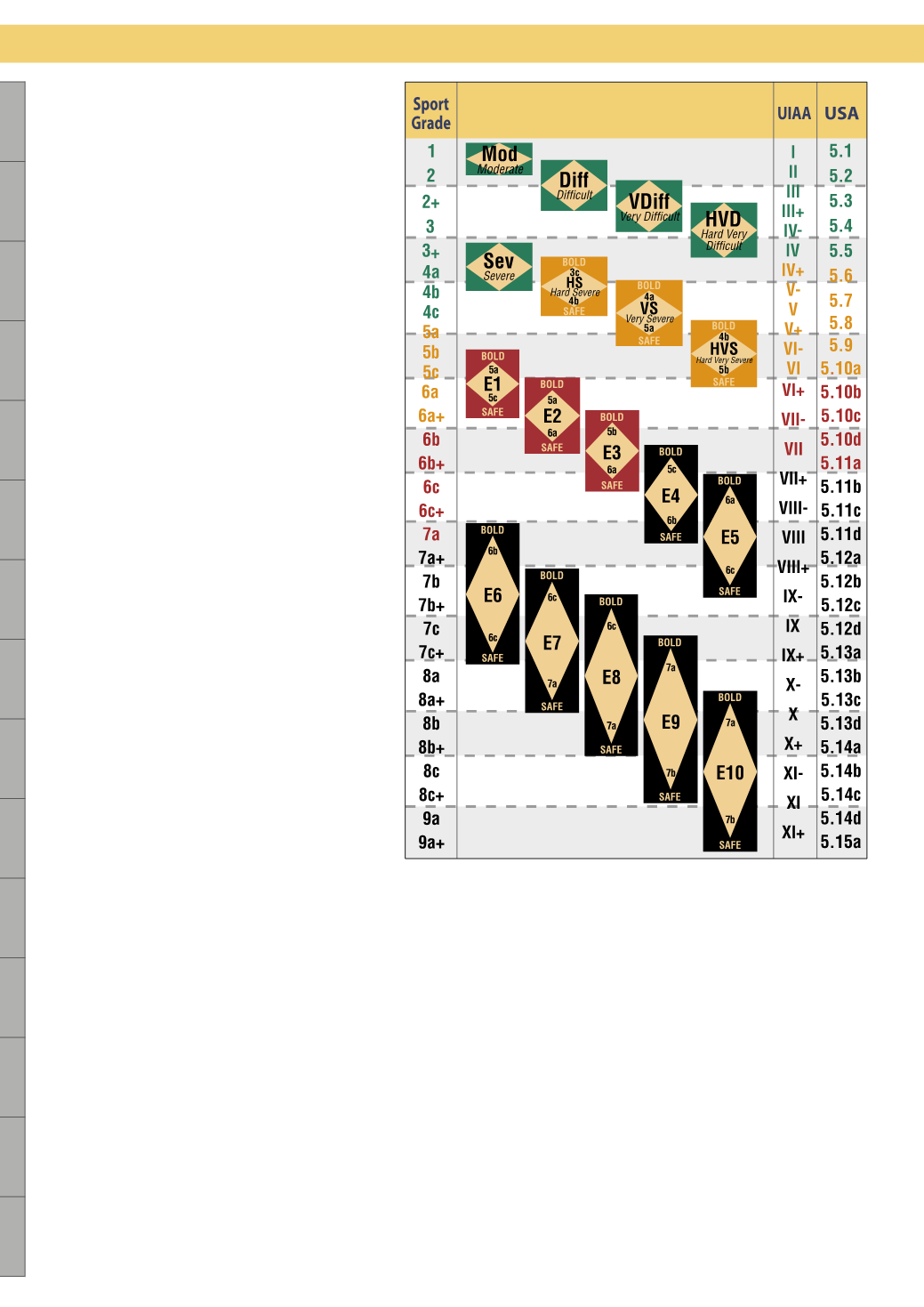
The routes in this book are given one
of two different grades depending on
whether they are a trad route or a sport
route. The table to the right roughly
compares the sport and trad grade with
two other international grading systems.
On trad routes the majority of the gear
is carried by the lead climber and is
hand-placed.
A sport route is defined as one where
all the major protection comes from
gear fixed in the rock (bolts).
British Trad Grade
1) Adjectival grade (Diff, VDiff,
Severe, Hard Severe (HS), Very
Severe (VS), Hard Very Severe (HVS),
E1, E2 ... to E10).
An overall picture of the route including
how well protected it is, how sustained
and a general indication of the level of
difficulty of the whole route.
2) Technical grade (4a, 4b, 4c ... to 7b).
The difficulty of the hardest single
move, or short section.
Sport Grade
The sport grade is a measure of how
hard it is going to be to get up a certain
section of rock. It makes no attempt to
tell you how hard the hardest move is,
nor how scary a route is.
Colour Coding
The routes are all given a colour-coded dot corresponding to a grade band. The colour
represents a level that a climber should be happy at, hence sport routes tend to be technically
harder than the equivalent coloured trad routes because the climber doesn't need to worry
about the protection.
1
Up to Severe / Up to 4c
Mostly these should be good for beginners and those wanting an easy life.
2
HS to HVS / 5a to 6a+
General ticking routes for those with more experience.
3
E1 to E3 / 6b to 7a
Routes for the experienced and keen climber. A grade band which includes many of the
area's great classics.
4
E4 or 7a+ and above
The really hard stuff including some of the top sport routes in the country.
British Trad Grade
Ruthin Area
Devil's Gorge
Maeshafn Pot Hole Quarry Minera Quarry
World's End
Craig Arthur
Twilight Area
Pinfold
Monk's Buttress
Dinbren
Trevor Area
Pandy Outcrop Llanymynech
Pontesford
32
Clwyd Limestone Climbing
Grades


